How to Store Children’s Medicines Safely When You Have Young Children at Home
Storing children’s medicines incorrectly can reduce their effectiveness or create dangerous risks. Learn practical, expert-backed storage tips to keep medicines safe, potent, and out of reach of young children in your Phnom Penh home.
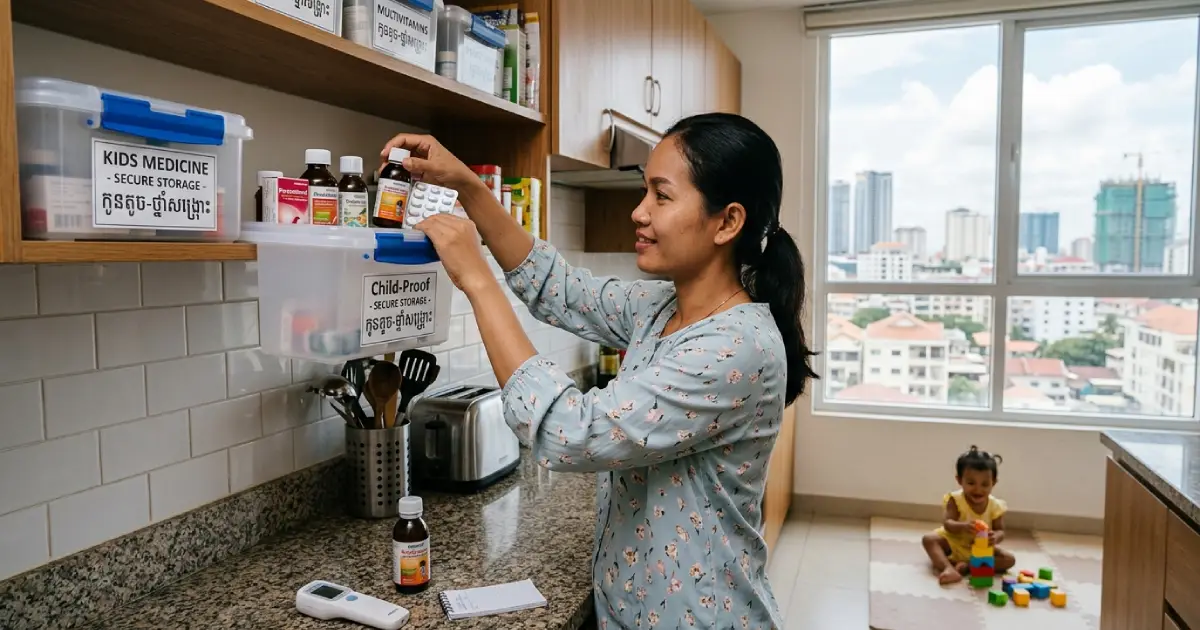
Why Proper Medicine Storage Matters for Young Children
As a clinical pharmacist who has worked with families across Phnom Penh for many years, one of the most common — and preventable — risks I see in households with young children is the improper storage of medicines. A bottle of paracetamol syrup left on the kitchen counter, fever medication stored above a steaming rice cooker, or an unlocked cabinet within a toddler’s reach: these are everyday scenarios that can have serious consequences.
Cambodia’s tropical climate — with temperatures frequently exceeding 35°C and high humidity levels — creates particular challenges for medicine storage. Heat and moisture can degrade active ingredients faster than the expiry date suggests, meaning a medicine may look and smell fine but deliver far less than the intended therapeutic effect. For children, whose bodies are more sensitive to medication dosage and quality, this matters enormously.
This guide gives you a clear, practical framework for storing children’s medicines safely at home, based on clinical best practice and the realities of living in Phnom Penh.
1. Choose the Right Storage Location
The location where you store medicines is the single most important factor in preserving their safety and effectiveness. Most parents instinctively reach for the bathroom cabinet or the top of the kitchen shelf. Both are poor choices.
Avoid these common locations:
- Bathrooms: Steam from showers raises humidity, which can break down medicines quickly.
- Above or near the stove or rice cooker: Heat from cooking accelerates chemical degradation.
- Windowsills or sunny spots: Direct sunlight damages many liquid and capsule medicines.
Low shelves, bedside tables, or handbags: Any location a child under five can reach or find.
Choose instead:
- A dedicated medicine box or cabinet placed high up — ideally above 1.5 metres from the floor.
- A cool, dry room away from direct sunlight, such as a bedroom wardrobe shelf.
- A locked box or cabinet if you have children who are curious climbers.
In multi-storey homes or apartments common in Phnom Penh, a high shelf in a bedroom or a lockable storage cabinet is often the most practical solution.
2. Understand Temperature Requirements in Cambodia’s Climate
Most children’s medicines, including paracetamol syrup, antihistamines, and oral antibiotics, are labelled “store below 25°C” or “store at room temperature.” In Cambodia, this instruction requires active attention — because our ambient room temperature regularly exceeds this threshold without air conditioning.
Temperature guide for common children’s medicines:
| Medicine Type | Storage Temp | Notes |
|---|---|---|
| Paracetamol syrup | Below 25°C | Refrigerate if home is hot; do not freeze |
| Antibiotics (liquid) | 2–8°C after mixing | Always refrigerate once reconstituted |
| Antihistamine syrup | Below 30°C | Avoid direct light |
| Eye/ear drops | 2–8°C | Refrigerate; discard 4 weeks after opening |
| Dry tablets/capsules | Below 30°C | Keep away from humidity |
If your home does not have air conditioning, consider storing temperature-sensitive liquid medicines in the refrigerator — in a sealed container clearly labelled “MEDICINE — DO NOT EAT,” placed on a high shelf out of a child’s reach, and away from raw food.
Stay updated on health & medicines in Cambodia
Join our community for health tips, medicine guides and more.
3. Keep Medicines in Their Original Packaging
It can be tempting to consolidate medicines into a single container or remove bulky outer boxes to save space. This is a risk you should avoid.
Original packaging contains critical information: the full medicine name, strength, dosage instructions, batch number, and expiry date. For children’s medicines — where dose precision is directly linked to the child’s weight or age — losing this information can lead to under- or over-dosing.
- Always keep the patient information leaflet inside the box. It contains dosage by age/weight, overdose warnings, and contraindications.
- Keep blister packs intact rather than popping tablets out in advance.
- For liquid medicines, keep the original measuring syringe or cup. Kitchen spoons are not accurate enough for paediatric dosing.
- If you transfer medicine to a travel container, write the medicine name, strength, dose, and expiry date clearly on the container.
4. Use Child-Proof Containers and Locks
Children under five are naturally curious and fast. A medicine left within reach for even a few minutes can be opened and ingested. Accidental medicine ingestion is one of the leading causes of childhood poisoning in Southeast Asia.
Practical child-proofing measures for Phnom Penh homes:
- Use a dedicated lockable medicine box. These are available at pharmacies and hardware stores in Phnom Penh at affordable prices.
- Ensure all individual medicine bottles have child-resistant caps. If they do not, keep them inside a locked box.
- Never leave medicines on dining tables, kitchen benches, or sofas, even temporarily.
- After giving a child medicine, immediately close and return the bottle to its secure location — do not set it down “just for a moment.”
- Educate older children that medicines are not sweets, even if they taste sweet.
If you suspect a child has ingested medicine accidentally, contact the Calmette Hospital Poison Control line immediately and do not attempt to induce vomiting without medical guidance.
5. Check Expiry Dates Regularly
An expired medicine is not simply a medicine that has “just passed its date.” Depending on the type of medicine and storage conditions, it may have degraded in potency, changed chemical composition, or — in rare cases such as with certain antibiotics — become harmful.
Build a simple habit: every three months, go through your medicine box and:
- Check every expiry date. Discard anything expired.
- Inspect liquid medicines for changes in colour, consistency, or smell.
- Discard any medicine where the label is unclear or missing.
- Properly dispose of expired medicines — do not flush them down the toilet or put them in general waste. Return them to a MoH-verified pharmacy for safe disposal.
This quarterly audit also helps you restock medicines your child may need before you run out — particularly useful for common childhood illnesses during Cambodia’s rainy season.
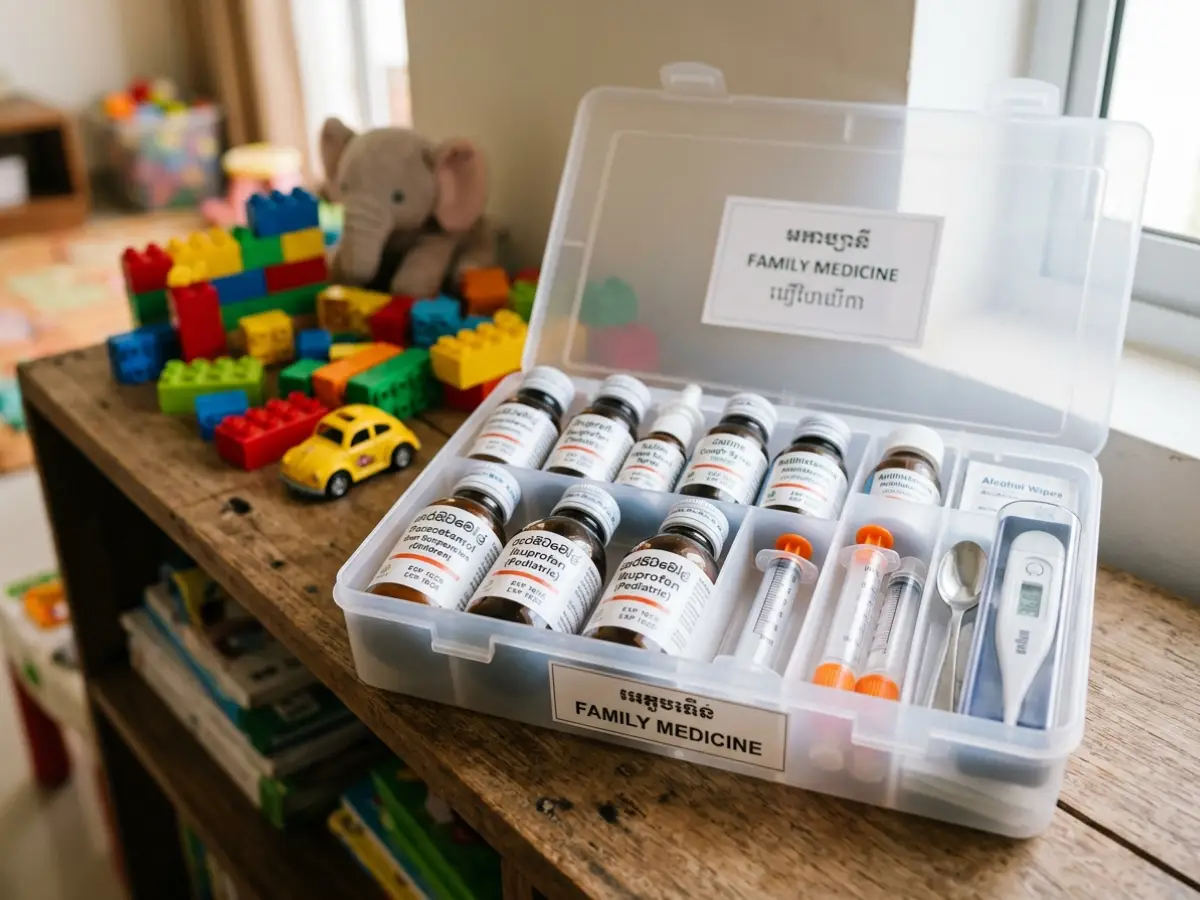
6. Organise Your Home Medicine Kit for Children
Having a well-organised children’s medicine kit at home means you can respond calmly and accurately during a fever or illness at 2am. Disorganisation leads to mistakes.
Recommended contents of a home paediatric medicine kit:
- Age-appropriate paracetamol syrup (e.g. 120mg/5ml for under-6s)
- Oral rehydration salts (ORS) — essential for diarrhoeal illness common in Cambodia
- Digital thermometer
- Sterile gauze and adhesive plasters
- Calibrated oral syringes (1ml, 5ml)
- Any prescribed medicines your child takes regularly
- A written emergency contact list: your paediatrician, nearest pharmacy, Calmette Hospital
Label each section of your box clearly. A simple colour-coded system, example: red for “urgent/prescribed”, green for “general first aid”, makes it easier for any caregiver to locate what they need quickly.
7. Special Considerations for Refrigerated Medicines
Some children’s medicines must be refrigerated: reconstituted antibiotics, certain vaccines (if stored at home under medical advice), and some eye drops. Managing these in a household refrigerator shared with food requires additional care.
- Store medicines in a sealed, clearly labelled container — never loose on a shelf.
- Place on the middle shelf of the refrigerator, away from the freezer compartment. Freezing destroys most liquid medicines.
- Never store medicines on the refrigerator door — temperature there fluctuates most with opening and closing.
- If the power goes out, most liquid antibiotics remain stable for up to 4 hours at room temperature. Check with your pharmacist if you are unsure.
- Mark the date you opened or reconstituted a medicine directly on the bottle. Most reconstituted antibiotics must be discarded after 7–14 days.
Frequently Asked Questions
Key Takeaways
Safe medicine storage protects your child’s health in two critical ways: it ensures medicines work as intended, and it prevents accidental ingestion. In Cambodia’s climate, this requires active management — not simply following the label.
- Store medicines in a cool, dry, dark location — never in a bathroom or above the stove.
- In homes without air conditioning, refrigerate temperature-sensitive liquid medicines in a sealed, labelled container.
- Always use a lockable or child-resistant container stored at height, out of children’s reach.
- Keep medicines in their original packaging with the information leaflet and measuring device.
- Conduct a quarterly medicine audit: check expiry dates, inspect liquids, and restock essentials.
- Dispose of expired medicines safely by returning them to a MoH-verified pharmacy.
- If a child accidentally ingests medicine, seek medical attention immediately — do not wait for symptoms.
This article is for general education purposes only and does not constitute medical advice. Always consult a qualified healthcare professional or pharmacist before making any health decisions.
Related articles